Updated September 2026. Originally published June 2024.
In June 2025 I started rebuilding the internal link structure of a B2B services site. Organic traffic that month was 4,774. The most recent month in the same report shows 18,918.
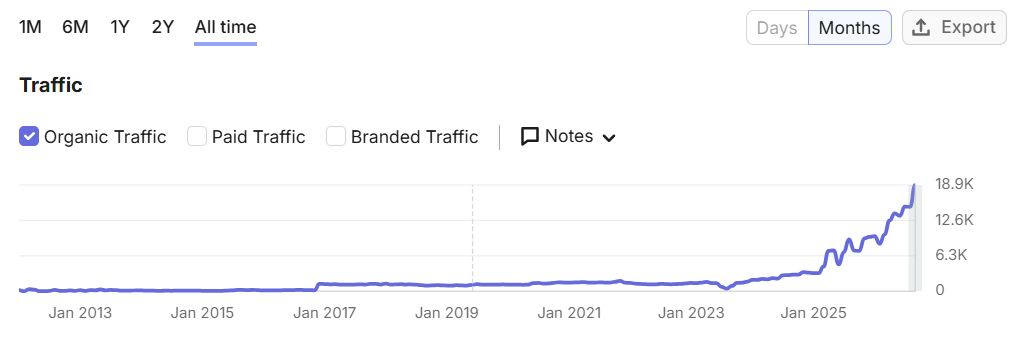
Organic traffic, all time, for the site described above. The silo work began in June 2025. The line was already climbing before that, which is exactly the point: the structure made everything else compound faster. It did not create the growth on its own.
I am putting that number at the top because it is the reason people read articles like this one, and I want to spend the rest of the article taking it apart. The silo did not produce that growth on its own. Nothing produces growth on its own. What the silo did was make everything else that was happening more precise, more consistent, more scalable, and comparably faster.
That is a smaller claim than the chart implies, and it is the honest one.
What I still do exactly the same way
The shape has not changed since I first wrote this article.
You build a pyramid. At the base sit the pages targeting the lowest demand: the specific, narrow, long phrasings that almost nobody searches for individually. Those pages link upward into the pages above them, which serve slightly broader intent. Those link upward again. At the apex sits the page you actually want to rank for the highest demand term in the category.
Link equity flows up the structure. Context flows down it. A visitor who lands anywhere in the pyramid can move toward the page that sells, and a crawler that lands anywhere in the pyramid can work out what the site is about.
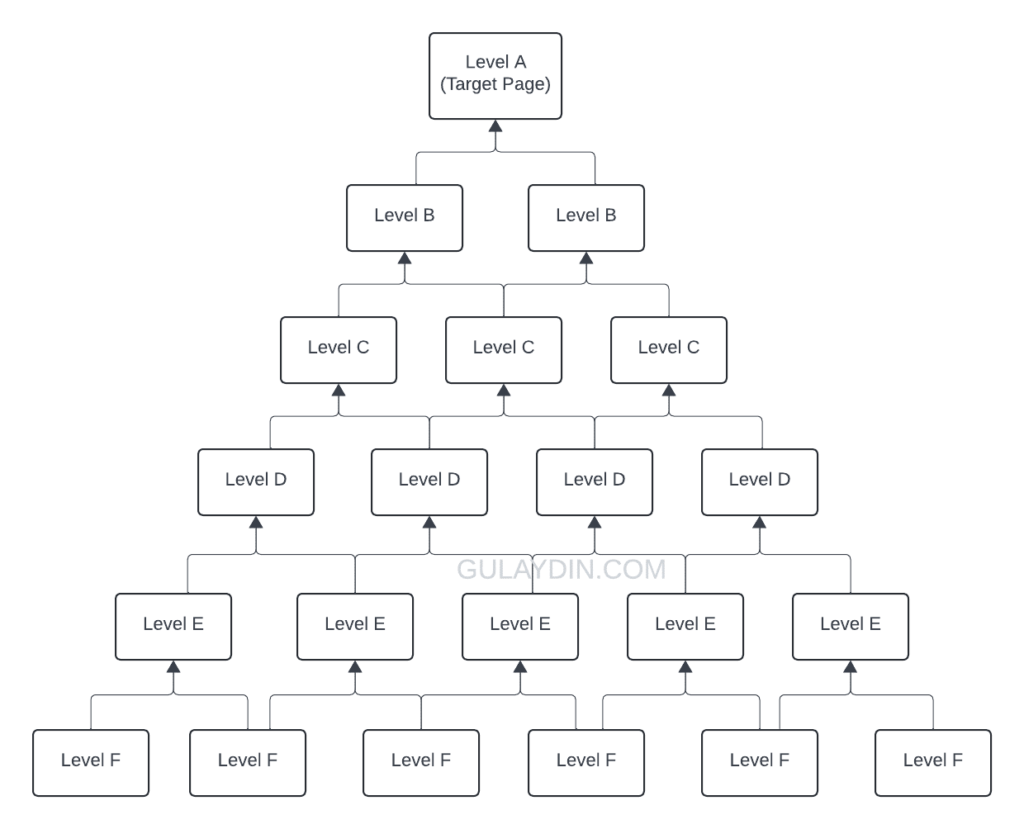
The structure I have used since 2018. Narrow pages at the base, broad intent at the apex, equity flowing up and context flowing down.
That part is unchanged and I would not change it. It has worked on every site where I have built it properly.
What changed, and why
The original version of this article told you to pick a target keyword for each page and link to that page using the keyword as the anchor text. Exact match, keyword to page, all the way up the pyramid.
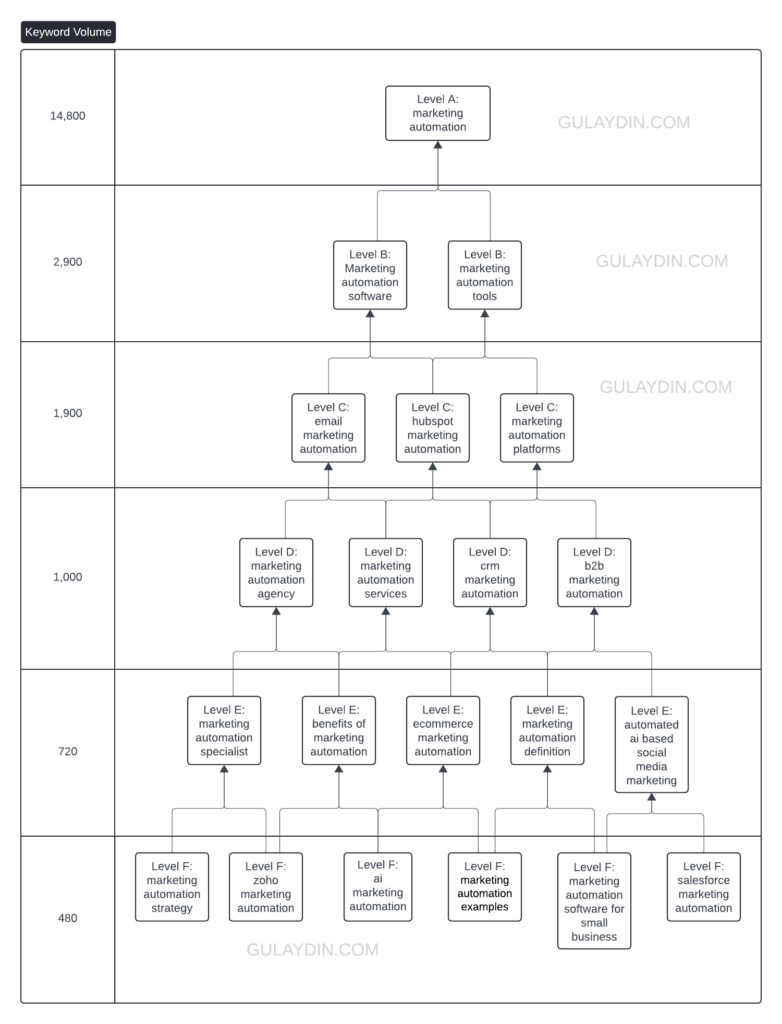
This is the diagram from the original 2024 article, with an exact match keyword assigned to every level. The levels are still right. The anchors are the part I would draw differently now.
I do not do that any more.
I choose semantic phrases instead. The anchor describes the destination in the language a person would actually use to refer to it, which is usually not the target term, and often is not a term with any recorded search volume at all.
The practical difference looks like this. An exact match structure links to a page about appointment cost using the anchor “cost per appointment” every single time, because that is the term the page targets. A semantic structure links to the same page using whatever the surrounding sentence needs: what a held meeting is worth, the number my sales team argues with me about, the only marketing figure my CEO reads. Each anchor is a different angle on the same page.
Three things improve when you do this.
- The link stops being an insertion. Exact match anchors have to be engineered into sentences. Semantic anchors are already there, because you were going to write that phrase anyway.
- The destination page accumulates meaning instead of repetition. Twenty different phrasings pointing at one page describe that page far better than the same two words twenty times.
- You stop building a footprint. Identical commercial anchors repeated across a site is a pattern, and patterns are the thing that gets classified.
You do not have to guess at these phrases. The tools already hold them. Anything that reports related terms, questions, and the phrasings a page already surfaces for will give you more usable anchors than you can place. I use Semrush and Ahrefs for this, but the source matters much less than the habit of looking instead of inventing.
The second job internal links do now
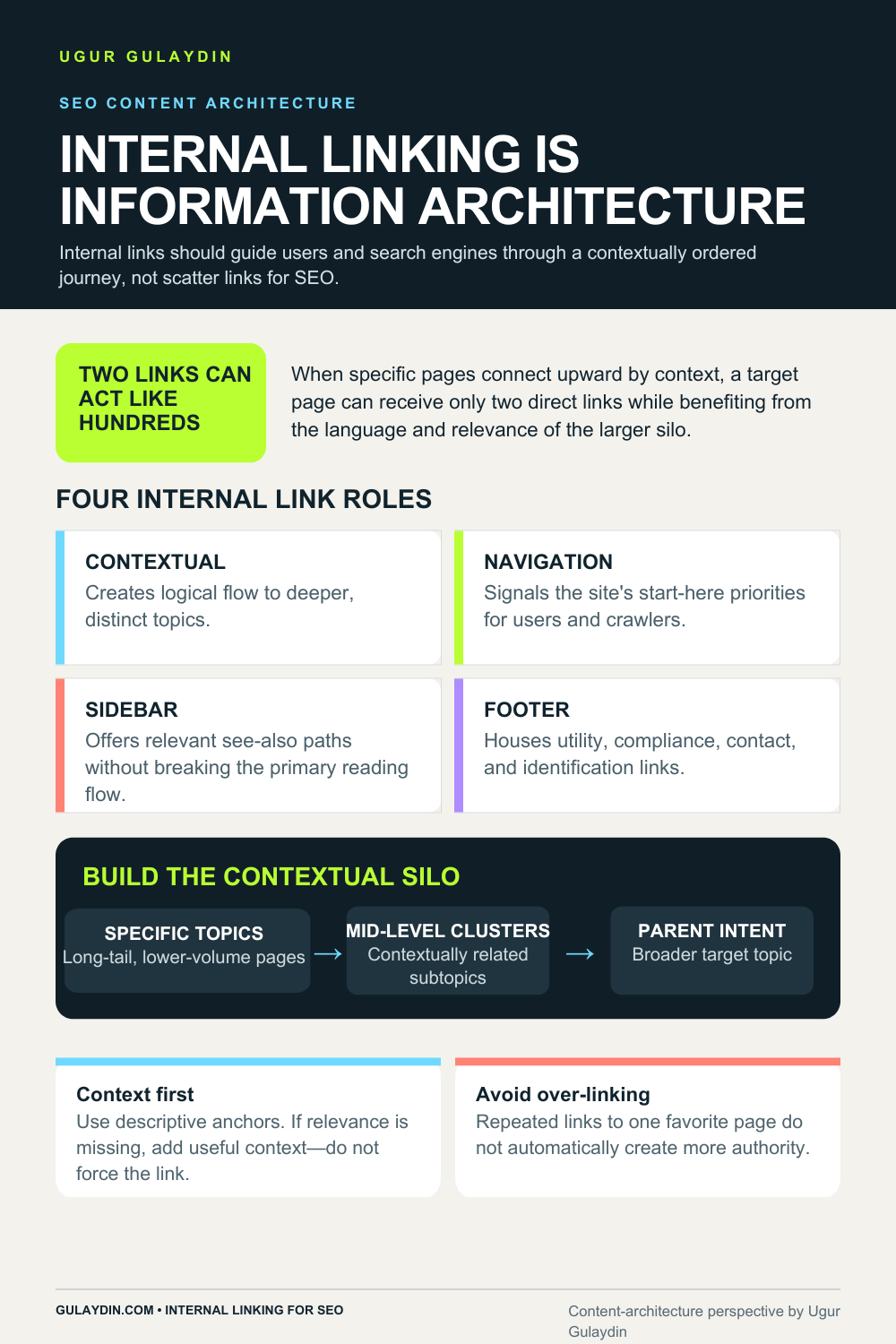
When I first wrote this, internal links had one purpose: move authority around so that the pages I cared about ranked.
They have a second purpose now, and on some sites it is the more valuable one.
Internal links build the context a language model uses to describe your brand. A model assembling an answer about your category is not only reading the page it landed on. It is reading what that page is connected to, what those connections are called, and whether the whole structure is consistent about what this company does and who it is for.
A site with a coherent silo tells a coherent story. A site with a flat structure and generic anchors has no story to tell, so the model writes one from whatever else it can find.
This matters most in the answers where nobody clicks anything. When a model summarizes a category and names three companies, the summary is the whole interaction for most readers. Being one of the three named is worth more than a position on a results page that the reader never scrolls to. I have written separately about what makes an individual page quotable in the piece on getting cited by AI. Internal linking is the site level version of the same problem. The page has to be citable. The structure around it has to make the citation make sense.
The contradiction I need to resolve
The original version of this article told you to use keyword volume as the basis for choosing your topics. Elsewhere on this site I have written that I have never picked a topic because of its search volume and am not suggesting you start.
Both of those statements are still on the site, and readers deserve to know which one I mean.
The answer is that they apply to two different decisions, and the original article blurred them.
Volume decides structure. Once you know your topics, volume tells you which page sits above which. That is what the pyramid is: an ordering by demand. Without volume data you cannot build the hierarchy, because you have no basis for deciding what is broad and what is narrow.
Volume does not decide topics. What you write about comes from what you actually know, what you have actually done, and what your buyers actually ask you. If you let a volume report pick your subjects you will write the same articles as everyone else who ran the same report, and you will have nothing to link together that is worth linking.
Pick topics from experience. Order them by demand. That is the whole reconciliation.
Why this site is not silo’d yet
Someone will check, so I will say it first. The site you are reading does not have a finished silo.
That is deliberate and it is a sequencing decision, not an oversight.
This site exists to establish a voice. Until the articles say something only I can say, there is nothing distinctive for a structure to organize, and a well built pyramid of undifferentiated content is a well built pyramid of undifferentiated content. So the order of work here is: rewrite every article around material I actually own, then build the structure over the top of it.
On a site whose job is to capture existing demand, I would reverse that. Structure first, because the demand is already there and the structure is what routes it. Different job, different order.
I am telling you this because most internal linking advice is written as though every site has the same objective. They do not. A demand capture site and an identity site need the same techniques applied in the opposite sequence.
What I check, and how often
Internal linking is maintenance, not a project. The structure decays every time you publish, because a new page arrives with links out and none coming in.
The recurring checks are short:
- Orphan pages. Any page with no internal links pointing to it. I run this in Semrush and Ahrefs, and I run it after every publishing batch rather than quarterly, because an orphan is cheapest to fix in the week it appears.
- Anchor repetition. If one phrase accounts for most of the links into a page, the structure has collapsed back into exact match without anyone deciding to.
- Depth from the home page. Anything more than three clicks deep is telling the crawler it does not matter, whatever you intended.
- Links that point sideways and never up. Related content links between peers are useful for readers and do nothing for the hierarchy. You need both, and it is easy to end up with only the first.
- Broken and redirected internal links. Every redirect in an internal link is a decision you made once and never cleaned up.
What the chart does not prove
Back to the number I opened with.
Between June 2025 and now, that site also published new content, improved existing pages, changed how it described its own services, and earned links it did not have before. I cannot hand you a clean attribution and neither can anyone else who shows you a chart like this one.
What I can tell you is what the silo changed about the work itself. Decisions that used to be arguments became lookups. Publishing a new page stopped raising the question of where it goes, because the structure answered it. The same method applied to the next category without being redesigned. And the gap between publishing something and seeing it move shortened, because the page arrived already connected instead of waiting to be discovered.
Precise, consistent, scalable, faster. That is what a silo buys you. The growth is bought by everything it makes possible.
If you want the measurement side of this, I have written about how I hold marketing to a financial number in what one sales appointment is worth, and about how the same discipline applies to testing in the year I lost most of my A/B tests.
This article was substantially rewritten in September 2026. The original version recommended exact match keyword anchors and used search volume as the basis for choosing topics. Both recommendations have been changed and the reasoning for the change is set out above. The pyramid structure, which was the core of the original, is unchanged. The traffic figures come from a B2B services site I work on; the site is not named and the figures are reported as they appear in Semrush.
New writing, when there is some
No schedule, no forwarding your address, one click to leave.