Updated September 2026. Originally published June 2024.
The most important sentence about your brand is now written by somebody else.
A buyer asks a model who the credible options are in your category. What comes back is a one line characterisation of you, assembled from your site, from third party mentions, from directories, from reviews. By the time that buyer reaches anything you wrote, your brand level value proposition has already been delivered on your behalf, paraphrased, by something you do not control.
Which changes where the work goes. Investing in the places models cite matters more than the paragraph about yourself on your own about page. What others say sets the demand. What you publish on your own properties should complete and corroborate that, not contradict it or try to substitute for it.
Only when those agree does a coherent picture of your brand exist, and a coherent picture is the thing that sells without you present.
The framework in the rest of this article has not changed since 2024. Where each level of it lives, and who delivers it, has.
What a value proposition actually is
Proposing value is not a marketing invention. It runs through every relationship, personal and commercial. The difference in business is that you can test it, because there is a transaction at the end that either happens or does not.
A business exists because it solves a problem. That is the whole premise. Yet most owners cannot say clearly what problem they solve that others do not, which is a definition problem long before it is a messaging problem.
You do not have to be the only one with a solution. You do have to be the only one at something while solving it. Faster, cheaper, better supported, more credible, easier to live with, less risky to buy. Pick the one that is true and defensible.
The hard part is not choosing it. It is communicating it in the right place, at the right moment, in the right amount. That is why levels matter.
Preoccupation, and the buyer’s existing state
Two ideas get conflated here, including by me in the 2024 version, so let me separate them.
Roy Garn, in The Magic Power of Emotional Appeal, argues that everyone you address is already preoccupied, and that your message has to break through that preoccupation. He groups the preoccupations into four: self-preservation, romance, money, and recognition. In business messaging, self-preservation and money do most of the work, recognition matters more than people admit, and romance is rarely your lever.
Separately, Joe Vitale’s buying trance describes the mental state a prospect is already in, and argues you should enter it using their own language rather than correcting them into yours. I wrote about the test that taught me this in the year I lost most of my A/B tests, where a plain page saying “breakneck fast” beat the technically precise version I preferred.
Preoccupation is what you are interrupting. The trance is what you enter once you have their attention. You need both, in that order.
The three levels
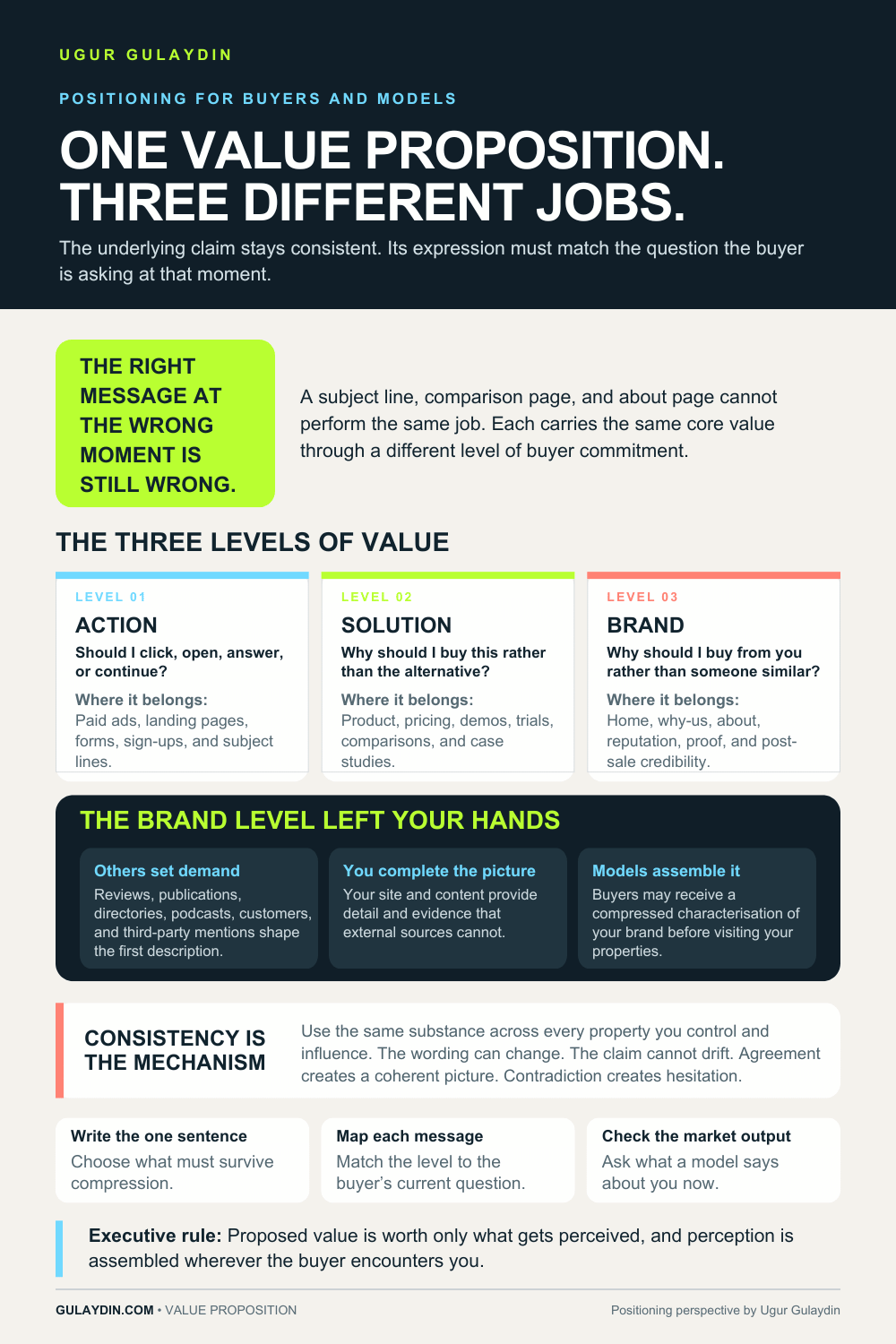
Each level answers a different question, and each question belongs to a different moment.
Action level
The question: should I click this, open this, answer this?
Nothing else has happened yet. Your prospect cannot evaluate your product because they have not granted you the attention required to describe it. So this level is about earning a micro-commitment, not about your product and certainly not about your brand. Bushra Azhar’s Mass Persuasion Method is worth reading for how these openings actually work.
The failure mode is talking about yourself before anyone has agreed to listen.
Solution level
The question: why should I buy this rather than the alternative?
Attention has been granted. Now specificity wins and clickbait actively hurts, because the tone that got the click destroys trust the moment the reader starts evaluating. Be honest, concrete, and comparative. This is where the meeting point from the go to market article belongs: accept the frame your buyer already holds, then put your alternative inside it.
Brand level
The question: why should I buy from you rather than from someone else offering roughly this?
Credibility, track record, who stands behind it, what happens after the sale. This level used to be delivered by your about page and your case studies.
It is now largely delivered by other people, and I will come back to that.
Where each level belongs
This is the part people get wrong most often, and the error is almost never the message itself. It is the placement.
- Home, why us, about: brand level
- Paid ads, landing pages, forms, sign-ups, subject lines: action level
- Product, pricing, case studies, demos, trials, comparisons: solution level
The rule underneath the list matters more than the list: the right message at the wrong moment is still the wrong message.
If a prospect is already considering you and is now comparing your product against two others, talking about your brand story is bad timing and bad placement. They have moved past that question. They resolved it before they got here. Answering it again reads as evasion, because the thing they actually asked is going unanswered while you describe yourself.
The same applies in reverse. Leading with feature-level comparison to someone who has never heard of you asks them to evaluate a choice they have not yet decided to make.
So you do not have one value proposition expressed once. You have one proposition, expressed differently for each medium and each moment, matched to where the reader actually is. An email subject line, a comparison page and an about page are three different jobs carrying the same underlying claim.
What changed: the brand level left your hands
Here is the shift that matters most since 2024.
Your brand level value proposition is increasingly stated first by a third party, and most often by a model summarising your category. Three things follow from that, and they should change where you spend.
What others say sets the demand. Third party mentions, reviews, directories, analyst coverage, publications, podcasts, and the places your customers talk. These are what a model has to work with, and they carry more weight than your own description of yourself precisely because they are not your own description of yourself. Investing in being present and well described in those places now beats another pass over your about page.
Your own properties complete the picture rather than create it. Your site, your blog, your social presence. Their job is to corroborate, add the detail nobody else will publish, and give the specific evidence that a third party mention gestures at. When your material and the external material agree, the picture becomes coherent. When they disagree, the model hedges, and a hedged description is a lost comparison.
Consistency is the mechanism. The same claim, in the same terms, across every property you control and every place you can influence. Not identical wording everywhere, which reads as boilerplate, but the same substance without drift. Inconsistency is what stops a coherent brand picture from forming at all, because there is nothing for the different sources to converge on.
The underlying principle has not changed since the first version of this article. Proposed value is only worth what gets perceived, and perception is assembled from wherever your buyer encountered you. What changed is that the assembly now happens somewhere you cannot see, before you get a turn. I have written about what makes an individual page usable in that process in the piece on getting cited by AI.
An example from when I did this as a fractional CMO
For a period between two full time roles I worked as a fractional CMO, across cybersecurity, managed services and consumer ecommerce.
Take a search like “hire a fractional CMO for an ecommerce startup in personal accessories.” If that person landed on a page headlined “the world’s best fractional CMO,” the friction is immediate. It is broad, it is unverifiable, and it does not touch what they asked. A page headlined around ecommerce results does the opposite, because it matches what they are already holding in their head.
Same practitioner, same competence, same offer. The difference is entirely whether the message met the reader where they stood.
That example is now doing double duty, because the model answering that person’s question has to decide whether to mention you at all, and it makes that decision from what the wider web says about you, not from the headline you chose.
Practical notes
Write the one sentence version yourself. If your claim only works at four paragraphs, whatever survives compression becomes your brand value proposition, and it will be compressed. Decide what that sentence is rather than discovering it.
Prioritise your reader’s state over your own thinking. Your internal logic about your product is not the order in which a buyer needs to receive it.
Design supports the claim, it does not replace it. A beautiful page and a converting page are different achievements and occasionally the same page.
Test it, and test it where it lives. A proposition that wins on a landing page may lose in an email, because the moment is different. Test per medium, not once.
Check what a model says about you. Ask one who the options are in your category and read the answer carefully. That description is your brand value proposition as the market currently receives it. If it is wrong, generic, or missing, that is the work, and it is not on your about page.
This article was substantially rewritten in September 2026. The three level framework and the page mapping are unchanged from the original June 2024 version. The material on how the brand level value proposition is now delivered by third parties is new.