Updated September 2026. Originally published June 2024.
There is a complaint I have heard from more than one executive, in almost the same words every time. We are paying for SEO. Traffic is up. None of it shows up in the P&L.
The usual response is to go and optimise the pages. Rewrite the calls to action, test the forms, tighten the copy, run the conversion programme harder.
That is often the wrong repair. If the traffic arriving was never going to buy, no amount of conversion work will fix it. You are optimising the wrong end of the problem. The defect is upstream, in what you chose to rank for, and it was introduced before a single page was written.
That decision is keyword research, and the original version of this article got it wrong.
Keyword Research Used to Be an SEO Job. Not Any More.
The 2024 version of this article was a delegation guide. It told you how to brief your SEO team, which two reports to request, and how to review what came back. The underlying assumption was that keyword research is an SEO function that leadership supervises.
I do not believe that any more. I research keywords myself, and I would not hand the first pass of it to anyone.
Not because SEO people are not good at it. Because the inputs that make keyword research valuable are not SEO inputs.
Keyword research done inside the SEO function optimises for the metrics visible inside SEO tools: volume, difficulty, relevance to a seed term. That is a reasonable thing to optimise if those are the only inputs you have. But the priority list that comes out is sorted by demand, and demand is not the same as fit.
A thorough understanding of the brand, the services, and who actually buys them reorders that list completely. It changes the sort from volume to precision. Leadership is usually the only place where all of those inputs sit in one head.
The example that makes this concrete
Take two terms in the same category. One is definitional, the kind of phrase someone types when they are trying to understand what something is. The other names a specific service for a specific kind of buyer in a specific place.
In a real pair I looked at, the definitional term had roughly twice the monthly search volume of the commercial one.
Every volume-sorted report puts the definitional term first. It is the bigger number.
It is also close to worthless. The person searching it is a student, a curious employee, or someone three years away from having a budget. The commercial term, with half the volume, is a person with a problem, a budget, and a shortlist.
One of those terms moves MRR. The other moves a traffic chart.
The reason this keeps happening is not incompetence. It is that the person running the report cannot see it. Knowing which of those two terms matters requires knowing the ideal customer profile, the deal sizes, what the sales team can actually close, and where the blind spots are. Those are leadership inputs.
Two people want the same thing and type different words
This is the part that took me longest to see, and it is the reason volume-sorted lists fail so reliably.
Take an owner of a company with forty employees in one state, who has decided their IT situation is no longer tolerable. Now take someone else who is also, in some sense, looking into managed IT. A student. An internal IT manager benchmarking their own budget. Somebody thinking about starting a provider themselves. A consultant writing a report.
All of them are searching the same subject. None of them types the same thing, because they are not in the same situation, and the situation is what produces the words.
The owner has a constraint. They search like someone with a constraint:
- Managed IT services in their city or state
- IT support for their specific industry
- What managed IT costs per user, or per seat, per month
- Co-managed IT, because they already have one internal person
- Signs their current provider is failing
- How to get out of an IT contract
The others have curiosity, or a different job entirely. They search like it:
- What an MSP is, or what the acronym stands for
- Managed services versus professional services
- How to start an MSP
- The best tools MSPs use
- MSP industry size, margins, business model
Now look at what separates those two lists. Every term in the first one carries a qualifier: a place, an industry, a unit of cost, an existing arrangement, a trigger. Every term in the second one is definitional, aspirational, or supply side.
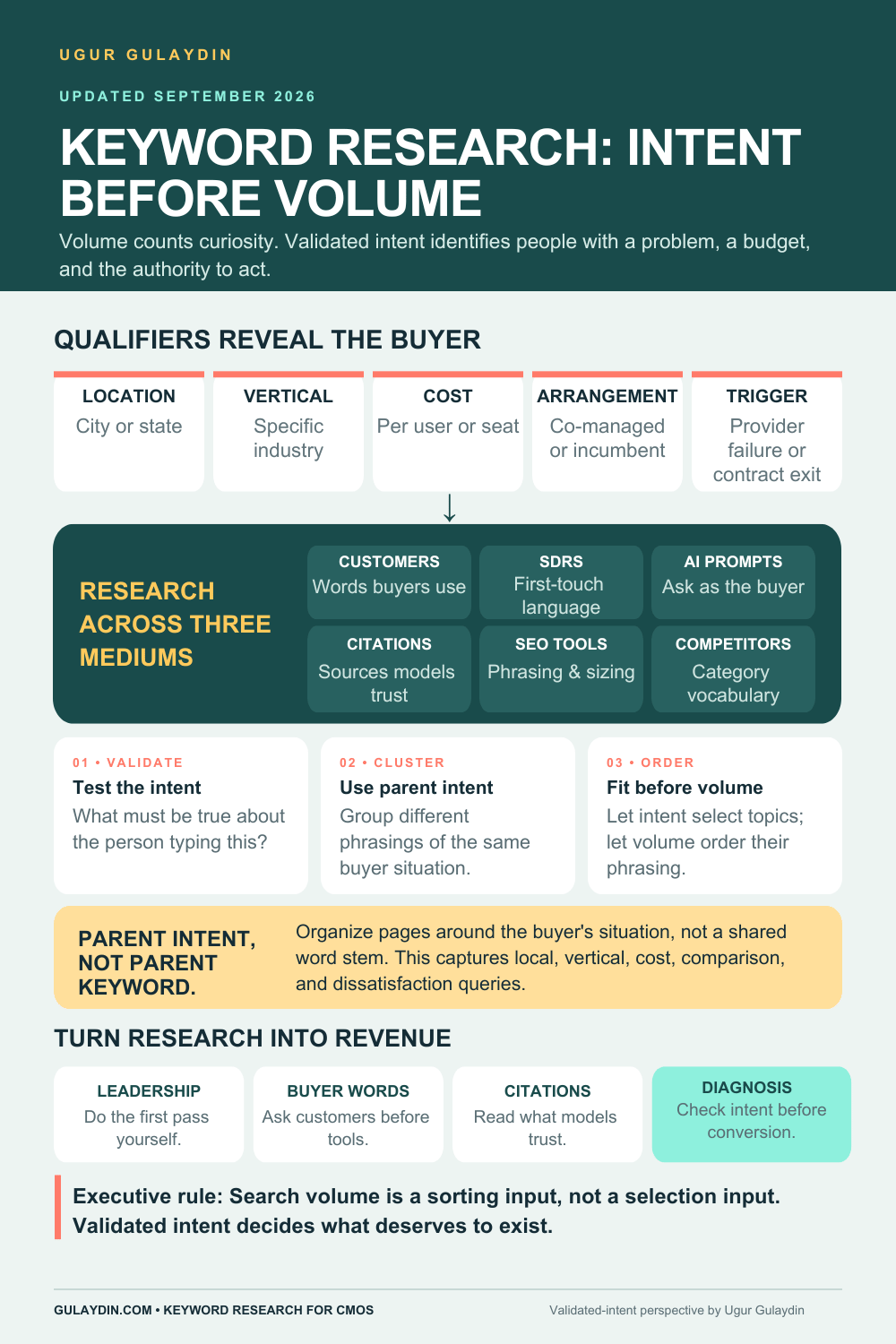
Qualifiers are the buyer narrowing themselves toward you. A person who adds their state to a query has just told you they are looking for someone local. A person who adds their vertical has told you they think their situation is specific. A person searching how to leave a contract has told you they have an incumbent and a grievance. None of that appears in a definitional query, because the person typing it has nothing to narrow.
Why this guarantees the wrong sort order
Here is the structural problem. Qualifiers always reduce volume. Always. Adding a state cuts the number. Adding an industry cuts it again. Adding urgency cuts it further.
And in any category, the people who are merely interested vastly outnumber the people who can actually buy. Students, employees, competitors, the curious. There are more of them, so their words have more volume.
Which means sorting a keyword list by volume does not just fail to find your buyer. It systematically sorts your buyer to the bottom. Search volume is a headcount of people who are curious. It is not a headcount of people who can sign.
This also explains why competitor keyword reports are so misleading. Your competitors are mostly chasing volume too, so their top pages are full of definitional terms. Copy their list and you inherit their mistake with a delay.
The test I apply to every term
One question, and it takes about three seconds.
What must be true about a person who types this?
If the answer includes a problem, a budget, and the authority to act, it is a commercial page and it belongs near the top of your list. If the answer is only that they were curious, it is a content page. Content pages are not worthless. They build the context that makes the rest of the site legible, to readers and increasingly to the models summarising your category, which I wrote about in the piece on internal linking.
But you must know which is which, and you must never let the two be reported in the same number. The moment definitional traffic and commercial traffic are added together into one line on a dashboard, the dashboard stops telling you anything, and that is precisely the point at which someone starts asking why SEO is not showing up in the P&L.
Validated intent, and where it comes from
The part of this work that has nothing to do with tools is the part that changes the answers most.
I survey existing customers. I have SDRs ask how people first came across us.
Not for attribution. I am not trying to build a source report. I am trying to capture the words they use.
Because there is always a gap between the words a company uses to describe itself and the words a buyer uses to describe the problem. The brand says it delivers proactive infrastructure management. The buyer says the network keeps dropping and nobody calls me back. Those are the same subject and they share almost no vocabulary.
Keyword tools will show you the second phrasing only if you already suspected it existed. Your customers will hand it to you if you ask.
This is the same principle I learned the hard way in conversion testing, one stage earlier in the funnel. I wrote about the test that taught it to me in the year I lost most of my A/B tests. A brand does not get to decide how its offering is described. The buyer decides. Your job is to find their language and use it, including the parts that sound wrong to you.
Validated intent is the term I use for a phrase that has passed that test. Not relevant, not high volume. Confirmed as something a real buyer said while describing a problem you solve.
Parent intent, not parent keyword
The mechanical change since 2024 is one word, and it reorganises everything underneath it.
The old method started with a parent keyword. You entered a broad term, expanded it, filtered out the obvious junk, exported the rest into a spreadsheet tab, and repeated for every parent term you had. The structure of your research was a list of seed words.
The method now starts with a parent intent. The unit is not a term, it is a situation a buyer is in, described in their language. Everything underneath it is phrasings of that same situation, which may share no words at all with each other.
What one parent intent looks like written down
Here is a real one, in the form I would actually record it:
“I need to find and evaluate an outsourced IT provider for my small business.”
That is not a keyword. Nobody types it. It is a description of a person in a situation, and it is the thing the whole cluster is organised around. Underneath it sit the supporting intents:
- What do managed IT services include?
- How much do managed IT services cost?
- Managed IT versus in-house IT
- How to choose a provider
- Local managed IT services in a named metro
- Managed IT services for a specific vertical, for example dental practices
- Signs my current IT provider is failing
Each of those becomes a page, and each of those pages links up to the parent service page.
Look at what that list contains. A cost question, a comparison, a selection question, a geographic qualifier, a vertical qualifier, and a dissatisfaction trigger. A parent keyword expansion on the term “managed IT services” would surface the first three and almost certainly miss the last one, because “signs my current IT provider is failing” shares no meaningful stem with the seed. Yet that last one is the highest buying intent on the list. Somebody writing that into a search box has already decided to leave.
That difference matters because the seed word version can only find things that resemble the seed. If your buyers describe the problem in vocabulary you did not think of, a parent keyword expansion will never surface it, no matter how many filters you apply. A parent intent is defined by the situation, so it can hold phrasings that look unrelated on the surface.
It also produces a better site structure, because the groupings are built around a buyer state rather than a word stem. That is what feeds the silo. I set out how that structure works, and why the anchors inside it changed too, in the piece on internal linking.
Where I run the research now
The research happens in more than one medium, and the mediums disagree with each other usefully.
Language models, prompted as a buyer. I write prompts that carry real buying intent for the category and see what comes back. Then I ask for the citations. That second step is the one people skip, and it is the valuable one, because it shows you what the model treated as authoritative when it decided how to answer. You are not just seeing the answer. You are seeing the sources that earned the right to shape it.
The traditional tools, still. Semrush and the rest have not stopped being useful. They are excellent at telling you how something is phrased and how much demand sits behind it. They are poor at telling you whether that demand is worth anything to you. Use them for phrasing and sizing, not for deciding.
Your own people. The customer and SDR conversations above. Lowest tooling cost, highest information value, and almost nobody does it.
Where the model citations and the keyword tools disagree is usually where the interesting work is. A phrase with negligible recorded search volume that keeps appearing in the sources a model cites is telling you something a volume report cannot.
What volume is actually for
I have argued elsewhere on this site that I have never chosen a topic because of its search volume. That is still true, and it is worth being precise about what I do use it for.
Volume does not decide what you write about. Validated intent decides that.
Volume decides ordering. Once you know which situations matter, volume tells you which phrasings of those situations are broad and which are narrow, and that ordering is what the site structure is built from. It is a sorting input, not a selection input.
The 2024 version of this article had that backwards. It told you to take the high-volume keywords from the gap analysis and promote them to your parent list, which is exactly the move that produces traffic nobody can convert.
Competitor research, and what it is actually good for
The original article recommended a competitor analysis before anything else, and I would still do one. But the reason has changed.
It is not there to give you a target list. Copying a competitor’s top keywords copies their positioning, including the parts of it that are not working for them and the parts that do not apply to you at all.
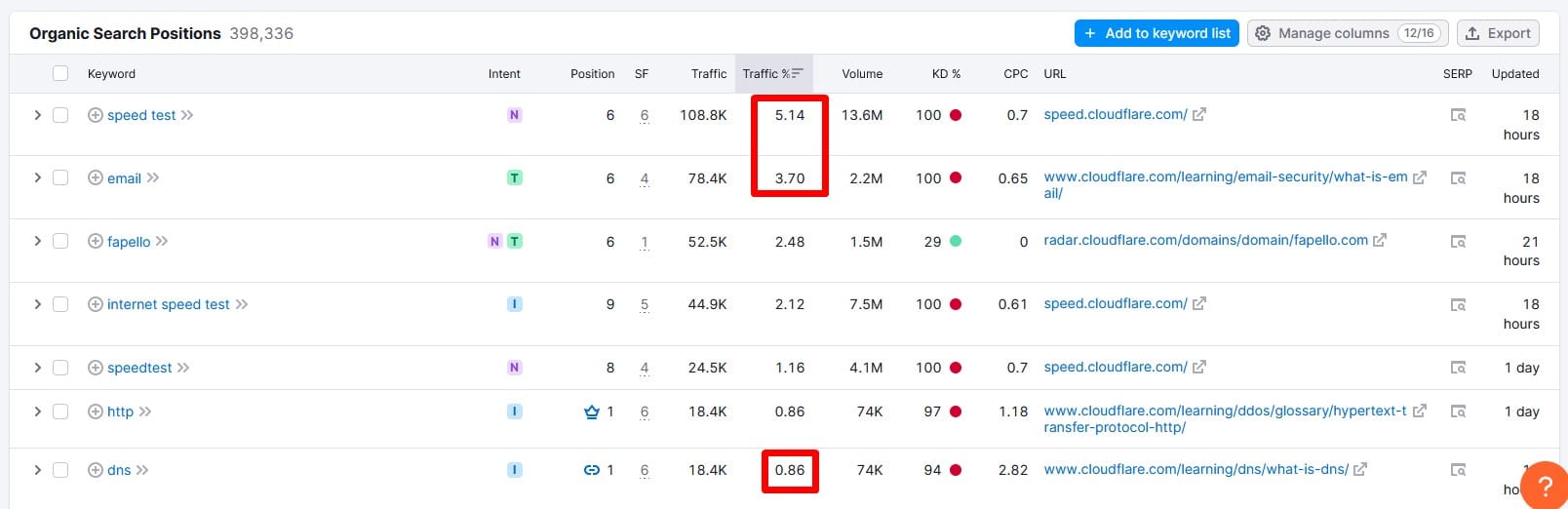
A competitor’s top non-branded terms, with the brand name filtered out. Read as a target list this is a trap. Read as a description of how the category talks about itself, it is useful.
It is there to show you the shape of the category as other people have chosen to describe it, so that you can see where your own description differs and decide whether that difference is a weakness or the whole point.
If you take one thing from this
- Do the first pass yourself. Not the exports and the deduplication. The decision about what matters. That one does not delegate.
- Ask your customers what words they used. Before any tool. It will change your list more than any filter will.
- Sort by fit, then by volume. In that order. Reversing it is the single most common and most expensive mistake in this work.
- Read the citations, not just the answers. When a model answers a buying-intent question in your category, what it cites tells you what it trusts.
- Before you blame conversion, check the intent. If good traffic is not converting, optimise. If the wrong traffic is not converting, optimising it will cost you a quarter and teach you nothing.
The measure that settles all of this is not traffic and not ranking. It is whether the work produced meetings worth having, which is the question I use for everything else too: what is one sales appointment actually worth.
This article was substantially rewritten in September 2026. The original June 2024 version framed keyword research as an SEO function for executives to brief and review, and recommended promoting high-volume keywords from a gap analysis into the priority list. Both of those recommendations have been reversed and the reasoning is set out above. The competitor analysis method from the original is retained with a different purpose. The parent intent method, the validated intent sections and the material on researching through language model citations are new. The illustrative example is drawn from a real pair of terms in a category I have not named.